(CLICK TO ENLARGE)
How much thought do you spare that dollar bill before you pass it through the drive-up window at your local Starbuck’s?
If you’re like most people, probably not much.
But that dollar bill of yours might have traveled the world. Or, if it’s unlucky, it might merely have circulated from one drive-though window to the next in your home town.
And what about those dollar bills that come to you with oddball designs scrawled onto them with a ballpoint pen? Someone might have drawn glasses on old George Washington’s face. Some of the more artistically inclined might have turned him into a clown with bright purple hair. It happens. You might even end up with a dollar bill that has a cryptic phone number printed on its backside. Do you call that number before you hand your bill to the attendant at the local newspaper stand? Probably not.
Yes, dollar bills get around.
Unfortunately, they’re a bit like bees: They may travel, but they don’t live long.
A Brief Life
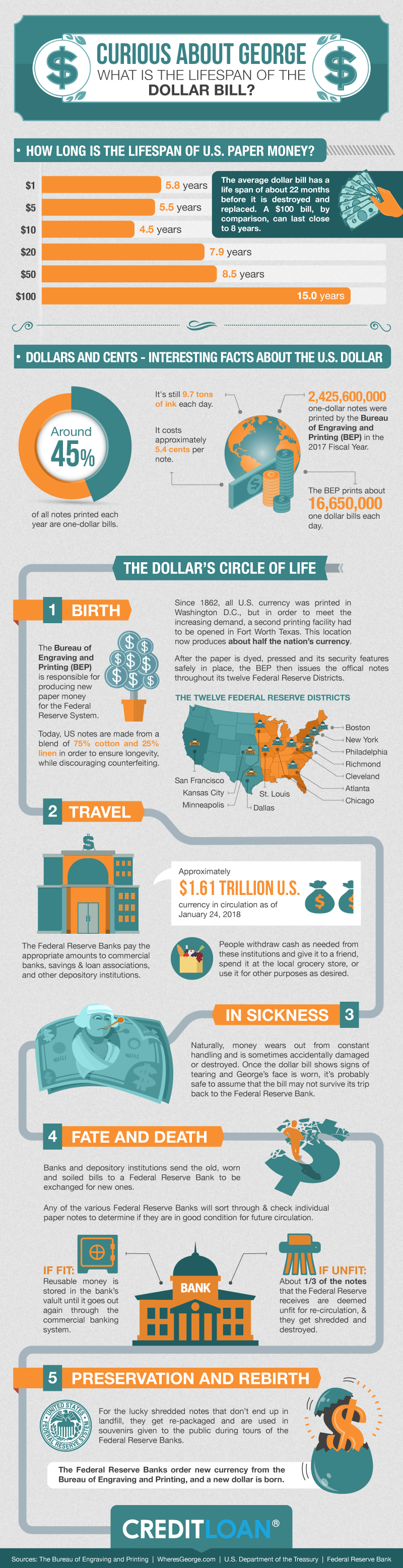
The average dollar bill generally lives for about 22 months before it needs to be removed from circulation.
This makes sense. Dollar bills get handled a lot. Think of all the bills you shuffle to cashiers throughout the day. You drop off dollars at doughnut counters, supermarkets, sandwich shops and train stations. You hand them off to bus drivers and barbers. You might even slip them under your son’s head on the nights he loses a baby tooth.
You might think that dollar bills, because they get handled so much, have a shorter lifespan than do other types of paper currency.
But, you’d be wrong.
Take the $5 bill. Its life span is just 16 months. And $10 bills also do worse than dollar bills: They generally remain in circulation for 18 months.
It’s not until you get to the higher denominations, which don’t get passed around as much, that you see bills enjoying longer life spans.
The $20 bill, for instance, generally lasts 24 months before they disappear from circulation. The $50 bill typically lasts for a robust 55 months.
But none of them can beat the $100 bill. This bill generally remains in circulation for 89 months. Of course, thanks to the nation’s struggling economy, the $100 bill is a rather rare creature.
The Mysterious $2 Bill
As bad as the $1 bill has it, though, its plight – a short lifespan – is nothing compared to the indignity suffered by its slightly more valuable peer, the $2 bill.
Many people mistakenly think that the U.S. Treasury no longer prints the $2 bill. That’s actually wrong. The Treasury has not removed these bills from circulation. They just think so lowly of them, that they order new printings of them in far lesser quantities. You can bet that this doesn’t do wonders for the confidence of these bills.
According to the U.S. Treasury, the Federal Reserve System last requested a new printing of the $2 bill in 2003. Treasury officials say that the key to boosting the popularity of the $2 bill is to encourage businesses and individuals to spend them just as they’d spend $1, $5 or $10 bills.
Unfortunately, many individuals tend to hang onto their $2 bills for the novelty value. For the record, though, these bills will never be worth more than $2 – so collectors shouldn’t be salivating over them.
According to the U.S. Treasury, as of April 30 of 2007, there was more than $1.5 billion worth of $2 bill in circulation across the globe.
So maybe that $2 bill isn’t such a sad sack, after all.
For more intriguing money facts, click on the infographic attached to this story. There’s a lot to learn about all those $1, $5 and $10 bills floating around out there.